
France Signals Powerful Nuclear Pivot as Macron Announces ‘Forward Deterrence’ Doctrine

France Announces Major Shift in Nuclear Strategy Under Macron
French President Emmanuel Macron has announced a major update to France’s nuclear deterrence strategy, introducing a new doctrine he described as “forward deterrence.” The announcement represents one of the most significant changes to the country’s nuclear policy in decades.
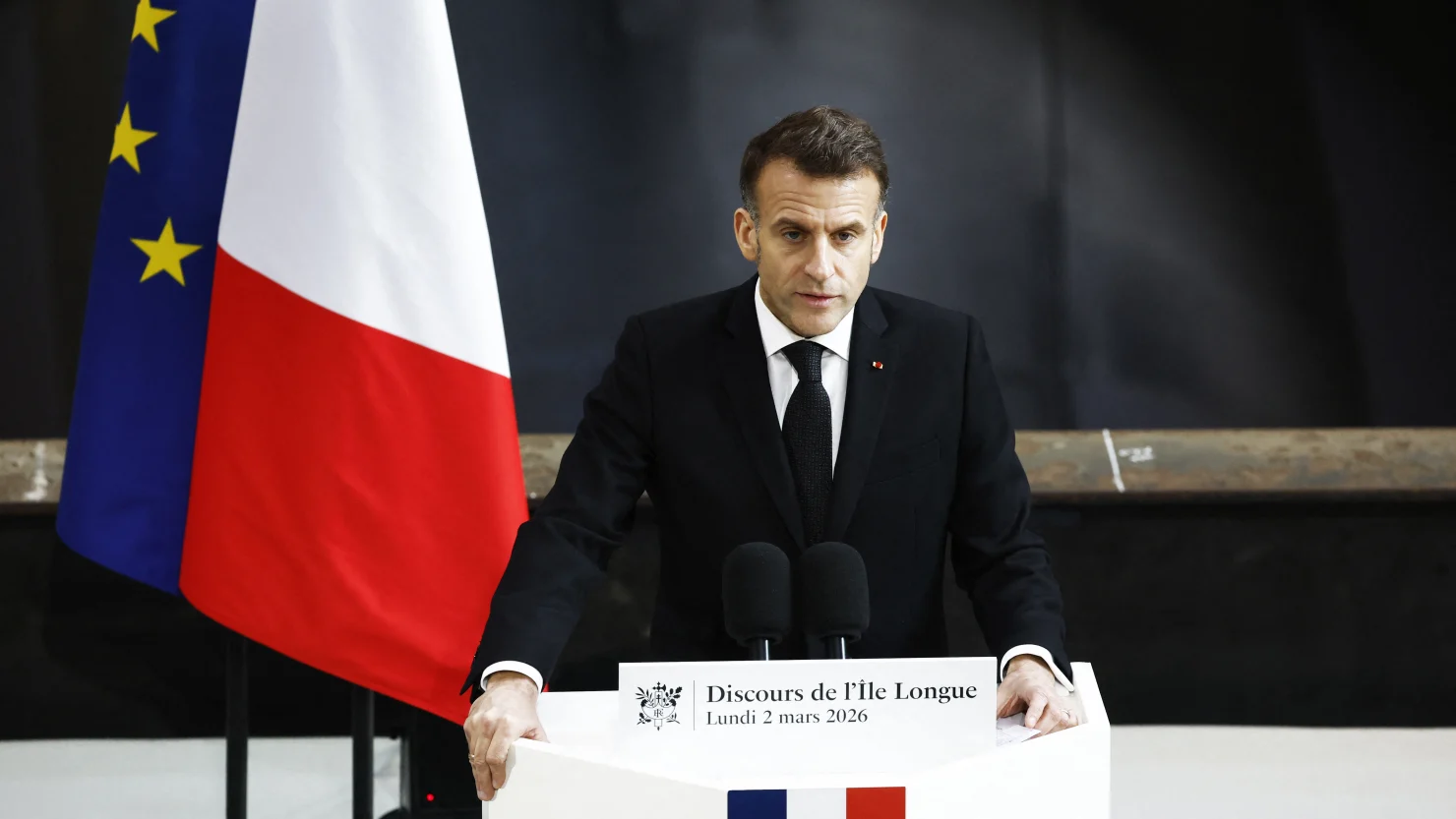
During a high-profile speech delivered at a naval base in Brittany, Macron outlined plans to strengthen France’s nuclear capabilities while deepening cooperation with European allies. The move signals a strategic shift in how France plans to use its nuclear arsenal as part of Europe’s broader security framework.
Experts say the policy update could reshape the role France plays in Europe’s defense landscape at a time of rising geopolitical tensions.
A Landmark Speech on Nuclear Deterrence
Macron delivered the speech from a naval base in Brittany, standing in front of the French nuclear-powered ballistic missile submarine Le Téméraire.
The 45-minute address focused on the role of nuclear weapons in maintaining national security and protecting European allies.
During the speech, Macron emphasized the importance of strength and credibility in deterrence.
He stated that national independence and security depend on maintaining powerful military capabilities, including a strong nuclear arsenal.
What “Forward Deterrence” Means
At the center of Macron’s announcement was a new strategy described as “forward deterrence.”
This approach signals a shift from a strictly national deterrence posture toward a more cooperative European framework.
Under this doctrine, France will not only maintain its nuclear deterrent but also integrate it more closely with the security interests of European allies.
The strategy includes expanding nuclear capabilities and strengthening joint military exercises with partner nations.
France’s Unique Position in Europe
France holds a unique role in European security.
Along with the United Kingdom, it is one of only two nuclear-armed states in Europe.
However, France’s nuclear system differs from the British model in an important way.
Unlike the United Kingdom, which relies heavily on cooperation with the United States for its nuclear deterrent, France maintains a completely independent nuclear weapons program.
This independence has long been a cornerstone of French defense policy.
Macron’s new doctrine seeks to preserve that independence while expanding cooperation with other European countries.
Expanding the Nuclear Arsenal
One of the most notable announcements from Macron’s speech was the decision to increase the number of nuclear warheads in France’s arsenal.
While he did not provide specific figures, the move signals that France is strengthening its nuclear capabilities in response to evolving global threats.
Macron also announced that France will no longer publicly disclose the exact size of its nuclear arsenal.
This change is intended to increase strategic ambiguity, making it harder for potential adversaries to assess France’s full capabilities.
Greater Cooperation With European Allies
Another key element of the new doctrine is increased cooperation with European partners.
Macron said several countries have expressed interest in participating in exercises related to France’s nuclear capabilities.
These countries include:
Germany
Poland
The Netherlands
Belgium
Greece
Sweden
Denmark
These nations could participate in training exercises involving France’s air-based nuclear forces.
Such exercises would allow European allies to gain familiarity with France’s nuclear deterrence strategy without directly possessing nuclear weapons themselves.
Possible Deployment of Nuclear Bombers in Europe
Macron also suggested that French nuclear-capable bombers could potentially be stationed at air bases in allied European countries.
While this would not involve transferring nuclear weapons to other countries, it would significantly expand the geographic reach of France’s deterrence posture.
Stationing aircraft in allied countries could allow France to respond more quickly to potential threats across Europe.
It would also send a strong political message about European unity in defense matters.
Strategic Timing of the Announcement
The announcement comes at a time of heightened geopolitical tensions in several parts of the world.
Ongoing conflicts and security concerns have led many European leaders to reconsider their defense strategies.
Recent military developments involving the United States, Israel, and Iran have also highlighted divisions within Europe over foreign policy and security responses.
Against this backdrop, Macron’s speech appeared aimed at reinforcing Europe’s strategic autonomy and defense capabilities.
Experts Call It the Biggest Shift in Decades
Defense analysts say Macron’s announcement represents a major turning point in French nuclear policy.
Bruno Tertrais, deputy director of the Foundation for Strategic Research, described the policy change as the most significant update to France’s nuclear deterrence strategy in 30 years.
According to Tertrais, the doctrine reflects a broader shift toward integrating France’s nuclear capabilities into Europe’s overall security framework.
The change could also strengthen France’s leadership role in European defense.
Europe’s Search for Strategic Autonomy
For years, European leaders have debated the need for greater strategic autonomy in defense matters.
Many countries still rely heavily on the United States for military protection through the NATO alliance.
However, some European policymakers believe the continent should develop stronger independent capabilities.
Macron has been one of the most vocal advocates of this idea.
His latest nuclear strategy announcement reinforces his long-standing call for Europe to become more capable of defending itself without relying entirely on external powers.
Implications for NATO and Global Security
France’s new nuclear strategy could have important implications for NATO and global security.
On one hand, closer cooperation with European allies could strengthen the continent’s overall defense posture.
On the other hand, expanding nuclear cooperation and increasing warhead numbers may also raise concerns about nuclear competition and arms escalation.
How other global powers respond to France’s updated doctrine will likely influence the broader geopolitical environment.
A New Chapter in France’s Nuclear Policy
Macron’s “forward deterrence” doctrine marks a new chapter in the evolution of France’s nuclear strategy.
By combining stronger nuclear capabilities with deeper cooperation among European allies, France appears to be positioning itself as a central pillar of Europe’s future defense structure.
Whether the policy will reshape the continent’s security landscape remains to be seen, but experts agree that the announcement signals a major shift in how France approaches nuclear deterrence in the 21st century.

