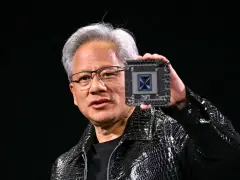
Nvidia’s Jensen Huang Says Markets ‘Got It Wrong’ on AI Threat to Software Companies

Nvidia CEO Jensen Huang believes investors have misunderstood the impact of artificial intelligence on the software industry.
“I think the markets got it wrong,” Huang said in an interview with CNBC, speaking to anchor Becky Quick.
His comments came just hours after Nvidia delivered an upbeat sales forecast, fueled by strong and sustained demand for AI chips.
Why Investors Were Worried
Over the past year, AI enthusiasm has driven massive spending on hardware, particularly Nvidia’s graphics processing units that power large language models and AI systems.
But investors have grown increasingly cautious. Two main concerns have emerged:
- Whether the surge in AI hardware spending is sustainable
- Whether AI agents could reduce demand for traditional enterprise software
Some market participants feared that advanced AI systems might automate tasks currently handled by software platforms, potentially weakening the business models of established enterprise software companies.
Huang’s Counterargument: AI Will Use More Software, Not Less
Huang strongly disagrees with the idea that AI will cannibalize the software industry.
Instead, he argued that agentic AI — AI systems capable of autonomously executing complex tasks — will rely heavily on existing software tools.
According to Huang, AI agents will:
- Use enterprise software more intensively
- Automate workflows within those platforms
- Increase overall productivity and efficiency
In his view, AI is not a replacement for software but a powerful layer on top of it.
He described the dynamic as counterintuitive: while AI may automate certain manual processes, it will also create new demand for software integration, orchestration and data management.
Nvidia’s Strong Outlook Reinforces Confidence
Huang’s remarks followed a bullish sales forecast from Nvidia, signaling that demand for AI chips remains strong despite concerns about market saturation.
The company has been at the center of the AI boom, supplying hardware to major cloud providers, startups and enterprise customers building AI-powered applications.
The upbeat forecast suggests that AI infrastructure spending is still accelerating, countering fears that companies may slow investment after the initial surge.
What This Means for Software Companies
If Huang’s view proves correct, software firms could benefit from AI in several ways:
- Faster development cycles using AI-assisted coding
- Smarter automation features embedded in existing products
- Higher customer engagement through AI-driven insights
Rather than replacing enterprise software platforms, AI agents may act as super-users, interacting with multiple systems and increasing their overall utilization.
This would mean that AI hardware providers like Nvidia and software companies could grow in tandem.
The Bigger AI Debate
The broader debate centers on whether AI will consolidate power among infrastructure providers or distribute gains across the technology stack.
Investors have poured billions into AI hardware, but skepticism has grown over whether that spending is sustainable in the long term.
Huang’s message is clear: AI is not a zero-sum game between chips and software. Instead, he sees a mutually reinforcing cycle where more AI capability drives more software innovation and usage.
For now, markets appear divided. But Nvidia’s strong forecast and Huang’s confident defense of the software ecosystem suggest the AI story is far from slowing down.