
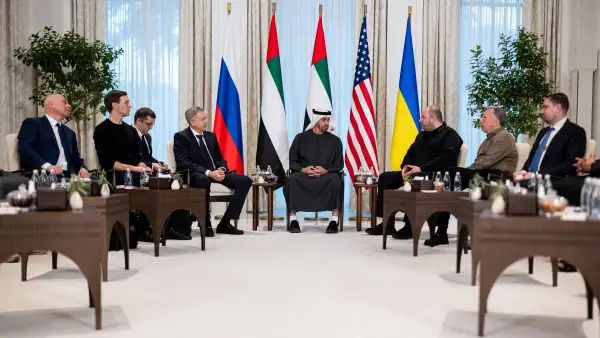

Russian and Ukrainian officials met in Abu Dhabi on Friday for a new round of peace talks, but early signals suggest the discussions remain deeply strained. At the heart of the negotiations lies one of the most sensitive and unresolved issues of the war: territory.
Both sides have acknowledged that land ownership, particularly in eastern Ukraine, is the primary obstacle to any peace agreement. While talks are expected to continue on Saturday, there has so far been no indication of a breakthrough.
The negotiations come at a time when Ukraine is facing its worst energy crisis since the war began nearly four years ago, following intensified Russian airstrikes across the country.
Donbas Remains the Core Sticking Point
The most contentious issue in the talks is Russia’s demand that Ukraine surrender full control of the Donbas region, a heavily industrialised area in eastern Ukraine that includes Donetsk and Luhansk.
Russia’s Position on Territory
Moscow has made it clear that it expects Kyiv to cede the entire Donbas region before it agrees to end the fighting. Russian officials argue that the territory is central to their war objectives and insist it must be recognised as no longer part of Ukraine.
This demand has remained unchanged despite years of fighting and repeated diplomatic efforts.
Ukraine’s Firm Resistance
Ukraine has categorically rejected Russia’s territorial demands, particularly the call to give up Donetsk. For Kyiv, surrendering land would not only violate its sovereignty but also set a dangerous precedent for future aggression.
Ukrainian officials argue that agreeing to such terms would reward military invasion and undermine international law.
Talks Take Place Amid Escalating Violence
The Abu Dhabi negotiations are unfolding against a backdrop of intensified Russian airstrikes, which have plunged Ukraine into its most severe energy crisis since the start of the war.
Critical infrastructure has been damaged, leaving parts of the country struggling with electricity shortages during harsh winter conditions. The timing has added urgency to the talks, but also increased pressure on Ukrainian negotiators.
Despite the violence, both sides agreed to sit down for discussions, reflecting the growing international push to explore a possible path to ending the conflict.
Zelensky Calls Territory the Central Issue
Ukrainian President Volodymyr Zelenskiy has publicly acknowledged that land is the defining issue in the negotiations.
Speaking ahead of Saturday’s continuation of talks, Zelenskiy said the territorial dispute was at the centre of the discussions involving Russian, Ukrainian, and U.S. officials.
“The most important thing is that Russia should be ready to end this war, which it started,” he said in a statement.
Zelenskiy added that he remained in constant contact with Ukraine’s negotiating team but cautioned that it was too early to draw conclusions from the initial discussions.
No Immediate Breakthrough Expected
While the talks are ongoing, expectations for a quick resolution remain low.
Zelenskiy said Friday’s meeting had not produced any immediate outcomes and that the real direction of the negotiations would become clearer after Saturday’s discussions.
“We’ll see how the conversation goes tomorrow and what the outcome will be,” he said.
This cautious tone reflects the long-standing mistrust between the two sides and the difficulty of resolving a war that has reshaped Europe’s security landscape.
Ukraine’s Negotiating Team Lays Out Next Steps
Rustem Umerov, secretary of Ukraine’s National Security and Defence Council and head of the Ukrainian delegation, described the discussions as focused on outlining the parameters for ending the war.
According to Umerov, the talks addressed:
- Possible frameworks for a ceasefire
- Broader principles for ending the conflict
- The structure and logic of future negotiations
However, the Ukrainian side stopped short of suggesting that any agreements were close.
Growing U.S. Pressure on Kyiv
The negotiations come amid increasing pressure from the United States for Ukraine to explore a negotiated settlement.
Washington has played a central role in supporting Ukraine since Russia’s full-scale invasion in February 2022, providing military aid, financial assistance, and diplomatic backing.
However, as the war drags on, U.S. officials are urging Kyiv to seriously engage in peace efforts, even as they continue to support Ukraine’s defence.
Zelensky Meets Trump Ahead of Talks
The Abu Dhabi negotiations follow a high-profile meeting between Zelenskiy and U.S. President Donald Trump at the World Economic Forum in Davos, Switzerland.
The meeting underscored Washington’s continued involvement in shaping the diplomatic track of the conflict and highlighted security guarantees as a key issue for Ukraine.
Zelenskiy later revealed that a deal on U.S. security guarantees for Ukraine was ready.
U.S. Security Guarantees Await Final Sign-Off
According to Zelenskiy, the agreement on U.S. security guarantees is complete and only awaits a specific date and location for signing, pending confirmation from President Trump.
These guarantees are seen by Kyiv as essential to any peace deal.
Ukraine fears that without firm security commitments from Western allies, Russia could use a ceasefire as an opportunity to regroup and launch another invasion in the future.
Why Security Guarantees Matter to Ukraine
Ukraine has repeatedly stressed that it will not accept a peace deal that leaves it vulnerable.
Key concerns include:
- Preventing future Russian aggression
- Ensuring long-term military and political support
- Creating enforceable deterrents against renewed invasion
Ukrainian leaders point to Russia’s past actions as evidence that verbal assurances alone are not sufficient.
A War That Has Reshaped Europe
Since Russia launched its full-scale invasion in February 2022, the conflict has resulted in:
- Massive civilian displacement
- Widespread destruction of infrastructure
- Deep changes to European security and energy policies
Despite several rounds of negotiations over the years, previous talks have failed to produce lasting peace.
What Comes Next in the Negotiations
With talks set to continue on Saturday, much depends on whether Russia shows any flexibility on territorial demands.
So far, neither side has signalled a willingness to compromise on core positions, making the path to peace uncertain.
Diplomats and analysts suggest that even incremental progress, such as confidence-building measures or partial ceasefires, could be significant given the current stalemate.
Final Thoughts
The Abu Dhabi talks highlight just how difficult ending the Russia–Ukraine war remains.
Territory, trust, and security guarantees continue to divide the two sides, even as international pressure to find a solution grows.
While negotiations are ongoing, the lack of early compromise suggests that any peace agreement will require major political shifts, sustained diplomacy, and strong international involvement.
For now, the war’s most critical question remains unresolved: who controls the land, and at what cost.

