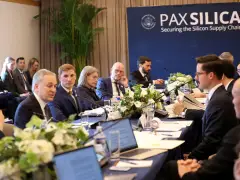

India has joined the U.S.-led “Pax Silica” initiative, a strategic effort launched under the Trump administration to secure global supply chains for silicon-based technologies.
The alliance focuses on strengthening supply resilience for semiconductors and other silicon-dependent technologies that power everything from smartphones and data centers to defense systems and electric vehicles.
According to Jacob Helberg, the U.S. undersecretary of State for economic affairs, the initiative is not designed to target any single country but to reinforce supply chain security.
“Pax Silica is really not about China, it is about America. We want to secure our supply chains,” Helberg told CNBC.
What Is Pax Silica?
“Pax Silica” is a U.S.-led coalition aimed at coordinating trusted nations around the production, processing and supply of silicon-based technologies.
Silicon lies at the heart of:
- Semiconductor chips
- Solar panels
- Advanced electronics
- Defense hardware
- Telecommunications equipment
Given recent disruptions in global supply chains and rising geopolitical tensions, countries are prioritizing partnerships that reduce overdependence on any single region for critical components.
The alliance seeks to build a more secure and diversified supply network across member nations.
Why India’s Membership Matters
India’s entry into Pax Silica is significant for several reasons.
1. Growing Semiconductor Ambitions
India has been actively pushing to develop its semiconductor manufacturing ecosystem. By joining this alliance, it gains closer collaboration with countries that already have strong chip design, manufacturing and equipment capabilities.
This could accelerate India’s plans to become a global electronics and semiconductor hub.
2. Strategic Position in Global Supply Chains
India offers:
- A large engineering workforce
- Expanding electronics manufacturing capacity
- A growing domestic technology market
Its participation strengthens the geographic diversification of supply chains and reduces concentration risk.
3. Deeper U.S.-India Tech Cooperation
The move also reflects expanding technology ties between Washington and New Delhi, particularly in areas such as semiconductors, defense tech and advanced manufacturing.
Who Else Is in the Alliance?
India joins a group of key U.S. partners in Pax Silica, including:
- Japan
- South Korea
- Singapore
- The Netherlands
- Israel
- The United Kingdom
- Australia
- Qatar
- The United Arab Emirates
These countries collectively represent major capabilities across chip fabrication, semiconductor equipment manufacturing, raw material supply and advanced research.
For example:
- Japan and the Netherlands are leaders in semiconductor equipment and materials.
- South Korea is home to some of the world’s largest chip manufacturers.
- Israel is known for advanced chip design and R&D.
By pooling strengths, the alliance aims to build a trusted network for silicon-based technology production.
Is This About China?
While U.S.-China technology competition forms the broader backdrop, U.S. officials have framed Pax Silica as a positive security initiative rather than an exclusionary bloc.
Jacob Helberg emphasized that the focus is on securing supply chains rather than targeting a specific country.
However, analysts widely interpret such alliances as part of a broader strategy to reduce reliance on Chinese manufacturing and processing capacity in critical technology sectors.
For many countries, the goal is not complete decoupling but diversification and risk mitigation.
How This Could Help Global Supply Chains
The semiconductor shortage during the pandemic exposed vulnerabilities in global production networks.
By coordinating across trusted partners, Pax Silica could:
- Improve transparency across supply chains
- Encourage joint investments in fabrication plants
- Secure access to raw materials
- Strengthen export controls and standards
- Enhance crisis response coordination
For multinational companies, this could mean more predictable supply flows and reduced disruption risk.
India’s Long-Term Tech Strategy
India’s decision to join Pax Silica aligns with its broader goals of:
- Expanding electronics manufacturing
- Attracting foreign semiconductor investments
- Becoming a trusted partner in global technology supply chains
- Reducing import dependence in strategic sectors
Participation in such alliances can also improve investor confidence by signaling policy alignment with major advanced economies.
The Bigger Picture: A New Era of Tech Alliances
Pax Silica represents a growing trend in global economics: technology alliances based on shared strategic interests.
As advanced technologies become central to national security and economic growth, governments are increasingly forming coalitions to protect supply chains and secure critical inputs.
For India, joining Pax Silica is more than symbolic. It positions the country at the table in shaping the future architecture of global semiconductor and silicon-based supply networks.
If successfully implemented, the initiative could help create a more resilient and diversified global technology ecosystem — one less vulnerable to shocks and geopolitical tensions.